How does the control of underfloor heating work?
To control the underfloor heating, a room thermostat is used. It measures how warm or cold it is in the room. It has a temperature sensor for this purpose. The thermostat then sends the values to the heating system, which adjusts the heating output accordingly. It gives instructions to the actuators that open or close the heating circuits.
To use the floor heating as efficiently and energy-saving as possible, the Building Energy Act (GEG) requires temperature control by room. This requirement can be easily met with the smart Shelly components.
Which components are needed to control the underfloor heating?
Basically, the type of control depends on the installed underfloor heating system. For example, it is possible to adjust the heating output via a manual controller or through the system itself. With Shelly, you don’t have to constantly go to the basement or get up to operate various controllers – you program everything automatically, inform your voice assistant that you’re too cold, or use the Shelly App comfortably from the sofa. We reveal what you need for this.
App comfortably from the sofa. We reveal what you need for this.
Control underfloor heating with the Shelly Wall Display
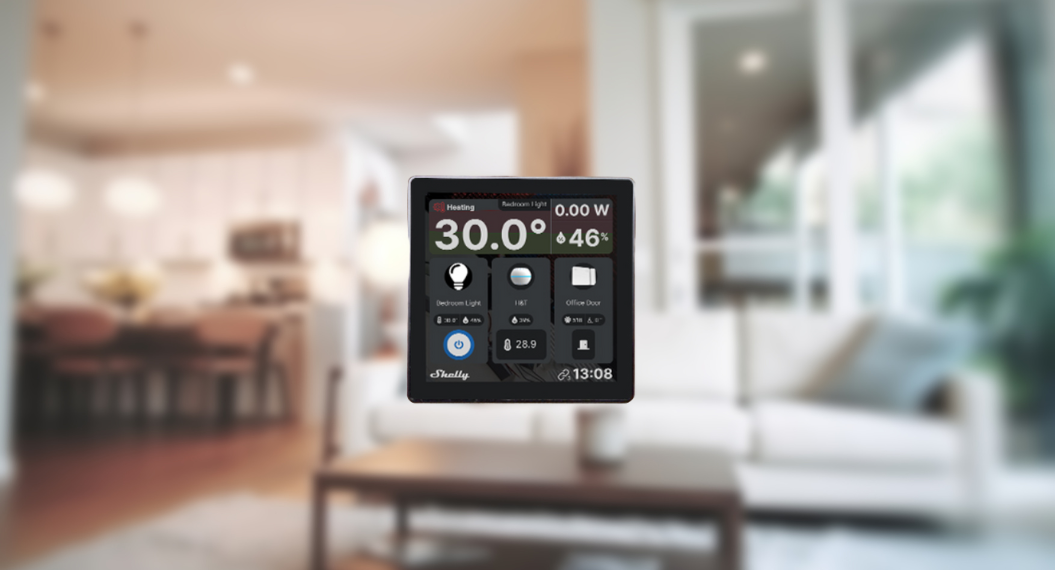
If you want a central place in your home to control your underfloor heating, the Shelly Wall Display is just right. The control panel for your smart home offers a 4-inch screen where you can not only manage the connected scenes and smart schedules of your devices but also monitor energy consumption. Additionally, it shows you the temperature and humidity in the room when connected to the Shelly BLU H&T Sensor . The display serves both as a control unit for Shelly devices and as a replacement for the conventional room thermostat (RTR).


Control water-based and electric underfloor heating
To be used as a room temperature controller, the Shelly Wall Display requires three connections: L, the conductor that carries the current; N, the neutral conductor, and O, the switched wire to control the heating. The maximum switching load of the device is 5 amps, which is approx. 1,150 watts. It can therefore control both water-based underfloor heating systems with 230 volt actuators and electric heating systems. If you need more than 5 amps, you can combine an additional relay.
If it is not possible to replace the RTR in your underfloor heating system, you can also install another Shelly actuator behind the existing RTR as a switching module - for example the Shelly 1 Gen3, 1PM Gen3 or Pro 1 or 1PM. But more on this later.

Shelly BLU H&T as room thermostat
The Wall Display works perfectly with the Shelly BLU H&T. The Bluetooth temperature and humidity sensor provides instant environmental data and acts as a smart room thermostat. This allows you to adjust the rules for controlling your underfloor heating even more precisely to the conditions in the room and not only ensure cosy warmth, but also a good indoor climate. After all, correct heating is not only cozy but also prevents damp walls or even mold growth. The small sensor has a battery life of up to three years.

Also usable without Wall Display
You can also use the measured values from the Shelly BLU H&T without the Wall Display to control the underfloor heating. For example, in combination with the Shelly 1 Gen3. It acts as an actuator for the actuators of a water-based underfloor heating system or controls the operation of the heating mats of an electric underfloor heating system. The BLU H&T then provides the necessary information for smart control. It regulates the control via actions, scenes, or the virtual thermostat in the Shelly app. So if it is too cold in the room, the smart home tells the Shelly 1 Gen3 to turn up the heat output so that you don't get cold feet.
Smart actuators control heating circuits and can be retrofitted
In addition to the Shelly 1 Gen3, there are many other smart actuators that can be used to control underfloor heating. They can be used both in conjunction with a smart room thermostat like the BLU H&T and with conventional RTR. Retrofitting smart components for your underfloor heating is therefore no problem. Let’s take a look at the different Shelly actuators.
Shelly 1 Gen3
The Shelly 1 Gen3 stands out, among other things, due to its so-called potential-free contacts. They are only powered by an external power source but do not transmit voltage themselves. This makes the switch particularly safe and flexible. It can also operate 24-volt DC actuators. Thus, it is compatible with numerous new heating systems. It’s best to check the technical details of your system or consult your heating professional. The Shelly 1 Gen3 also supports the installation of an add-on that makes automations even more versatile.
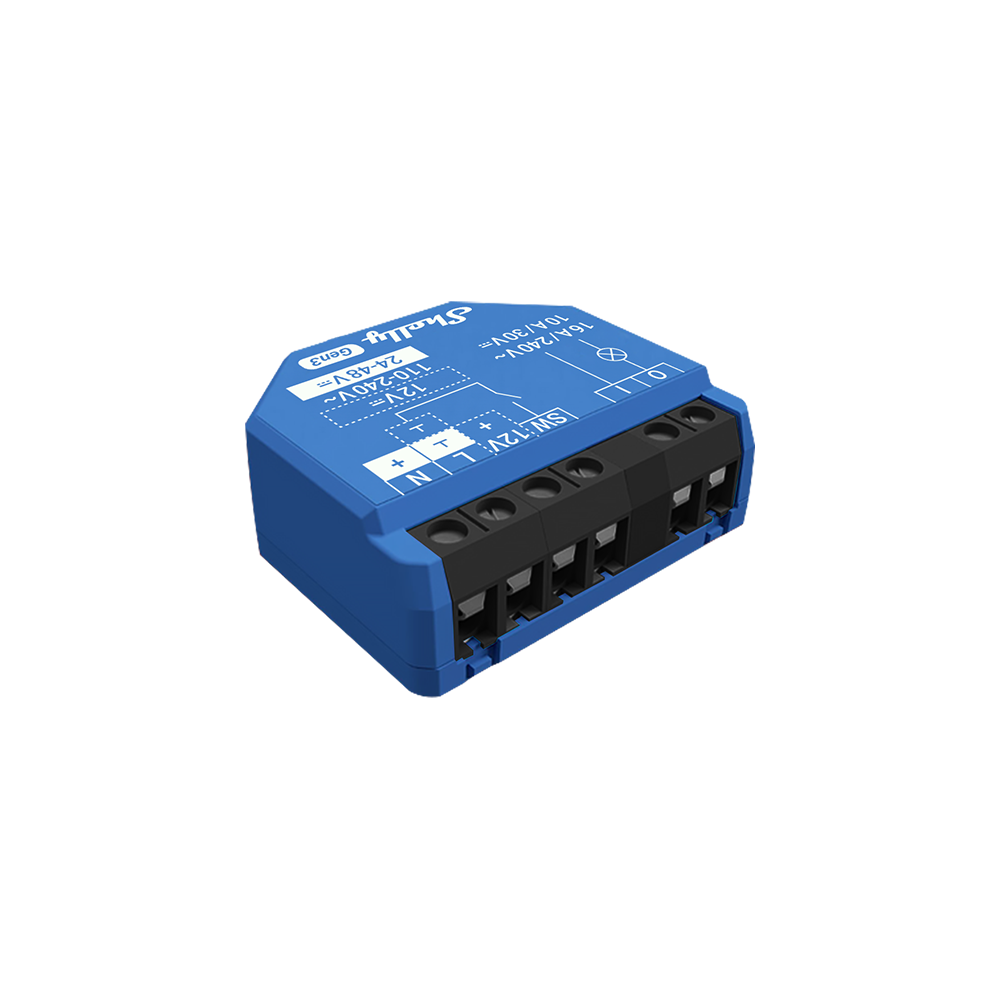

Shelly 1 Gen3
Shelly 1 Mini Gen3
If the installation of the smart actuator requires an especially small solution, the Shelly 1 Mini Gen3 is suitable. It supports up to 8 amperes but offers a particularly compact design, enabling very space-saving installation – for example behind switches, in flush-mounted boxes, or in the heating circuit distributor. Additionally, the small switch scores with Wi-Fi and Bluetooth and, thanks to potential-free contacts, also with a high level of safety.


Shelly 1 Mini Gen3
Shelly 1PM Gen3
The Shelly 1PM Gen3 is a WLAN-controlled smart switch with a maximum switching load of 16 amperes. Its features also include power monitoring. It stores the measurement data in the free cloud to optimize power consumption. For example, you can analyze how much electricity your electric underfloor heating consumes. The switch offers a high level of security and also serves as a range extender and Bluetooth gateway for other Shelly devices. You can expand the functionality of the Shelly 1PM Gen3 by adding an add-on – for example, a temperature sensor or a humidity sensor. You can install the Shelly 1PM Gen3 behind switches, sockets, in flush-mounted boxes, or directly in the heating circuit distributor.


Shelly 1PM Gen3
Shelly 1PM Mini Gen3
If you want power monitoring in addition to the features of the Shelly 1PM Mini Gen3 , the Shelly 1PM Mini Gen3 is the right choice. It also offers a switching load of 8 amperes and is suitable for use in tight spaces.


Shelly 1PM Mini Gen3
Shelly Pro Series: Control of heating systems without WLAN
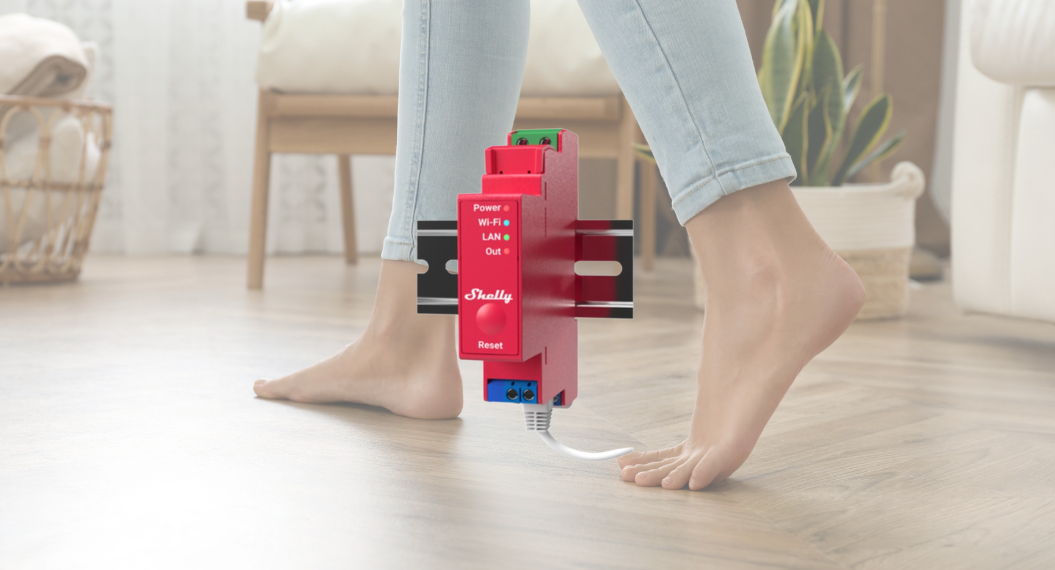
The top class of the Shelly product family are the Pro devices. If you want to install the smart switches on DIN rails in the heating circuit distributor or in the sub- or main distributor, the Pro devices are a good choice. They are also worthwhile for controlling the underfloor heating when no Wi-Fi reception is available and therefore LAN wiring is needed. Then the Pro 1/2, Pro 1PM/2PM, Pro 3, or Pro 4PM are available for controlling your floor heating. If these conditions are not met, networking your underfloor heating also works with the classic Shelly components.
The alternative: the Shelly BLU TRV thermostatic valve
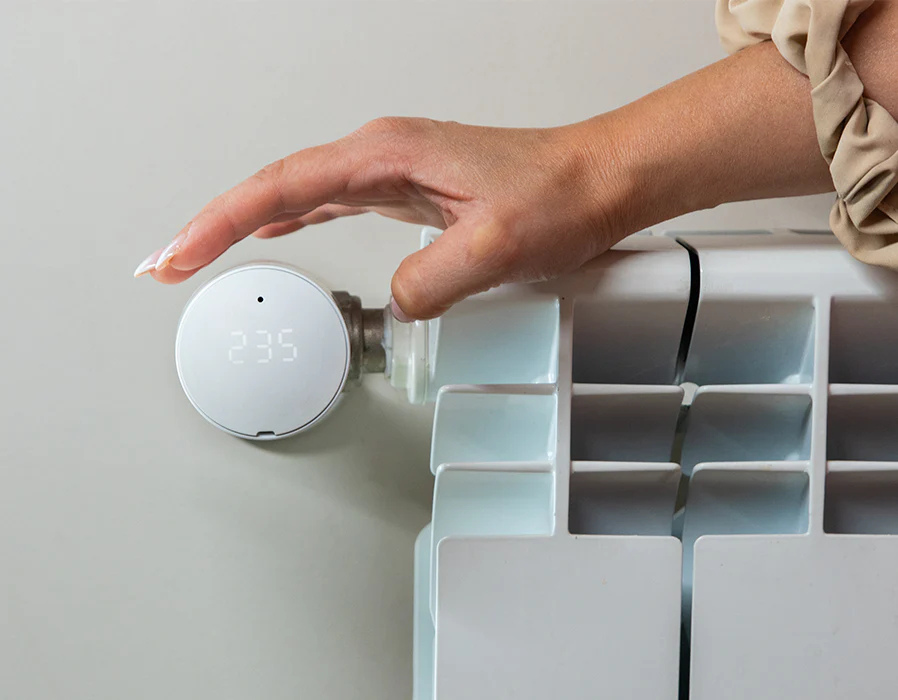
The Shelly BLU TRV thermostatic valve is installed directly on the heater. It serves as a smart replacement for the analog radiator or thermostatic valve. Depending on the installation location, you can also use it as an actuator for the valves of the heating circuits of the underfloor heating. The BLU TRV then conveniently receives commands via Bluetooth from the Gateway Gen 3 as an exclusive partner and adjusts the desired heating output accordingly. By the way, the gateway is always included in the delivery.
What do you need to consider when controlling underfloor heating?
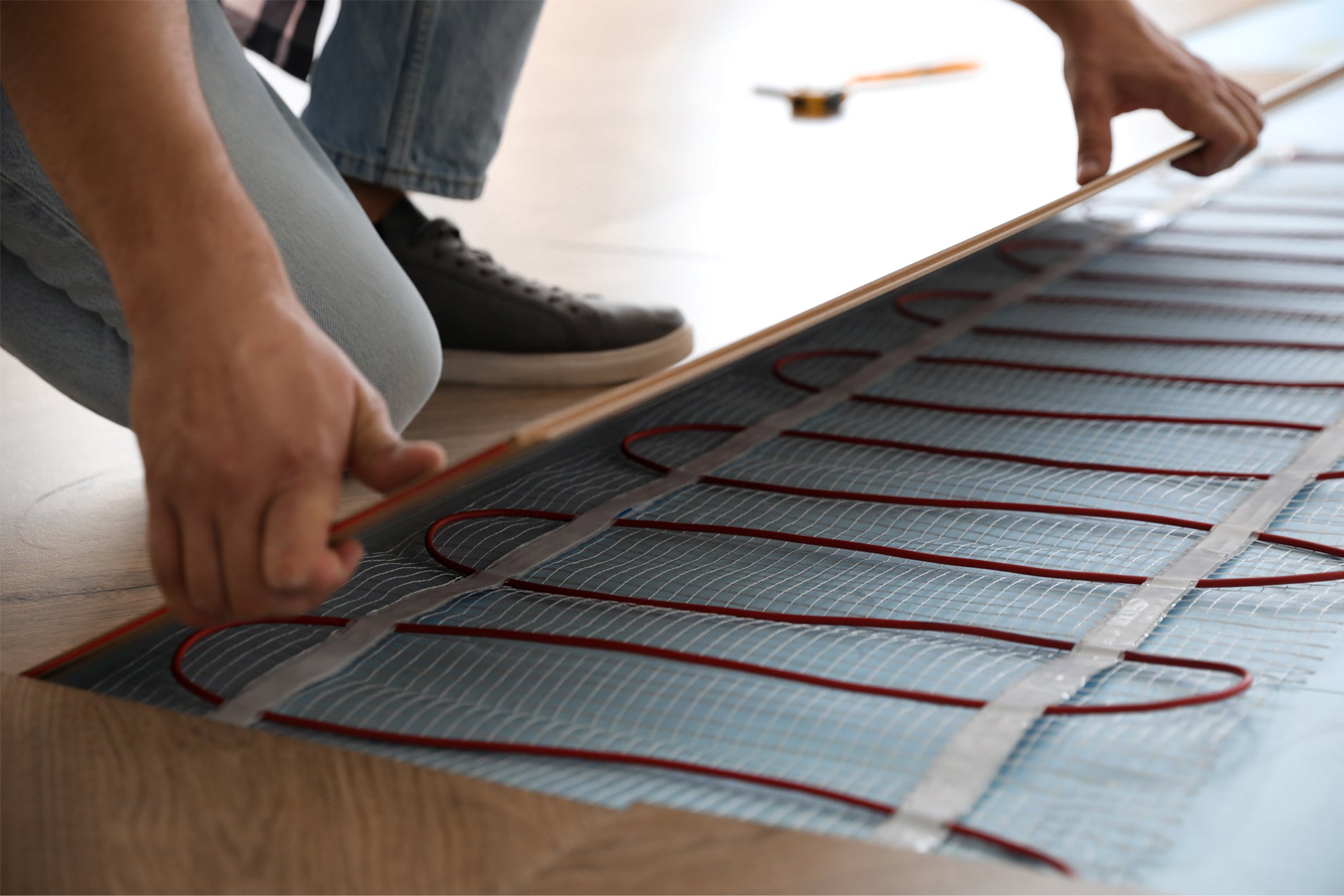
The control of underfloor heating differs in some points from the settings of classic heating systems. The biggest difference is the inertia of the floor heating. Due to its construction, it is a bit more relaxed when it comes to bringing a room to temperature. Since it takes longer for the floor to warm up and transfer the heat to the room, forward-looking control is important.
Energy efficiency and special features
For energy efficiency, it is advisable to control different rooms or zones separately, as the heat demand varies depending on use and location. Those who can use smart control for the underfloor heating are lucky. "Alexa, set the bathroom heating to 25 degrees at 6 a.m. tomorrow" – a sentence like this is enough for you to be welcomed with your comfort temperature.
Basically, the heating water of a floor heating system does not need to be as warm as, for example, in a radiator. Because the floor heating is a surface heating system and distributes the heat more evenly in the room.

Which room temperature controllers make sense?
To control the underfloor heating especially efficiently and comfortably, the thermostats monitor the heat output and automatically send a signal to the actuator when it should be warmer or cooler. With Shelly, the digital room thermostats can then be controlled via the app on the smartphone or the Wall Display. Let's take a closer look at the range of functions here.

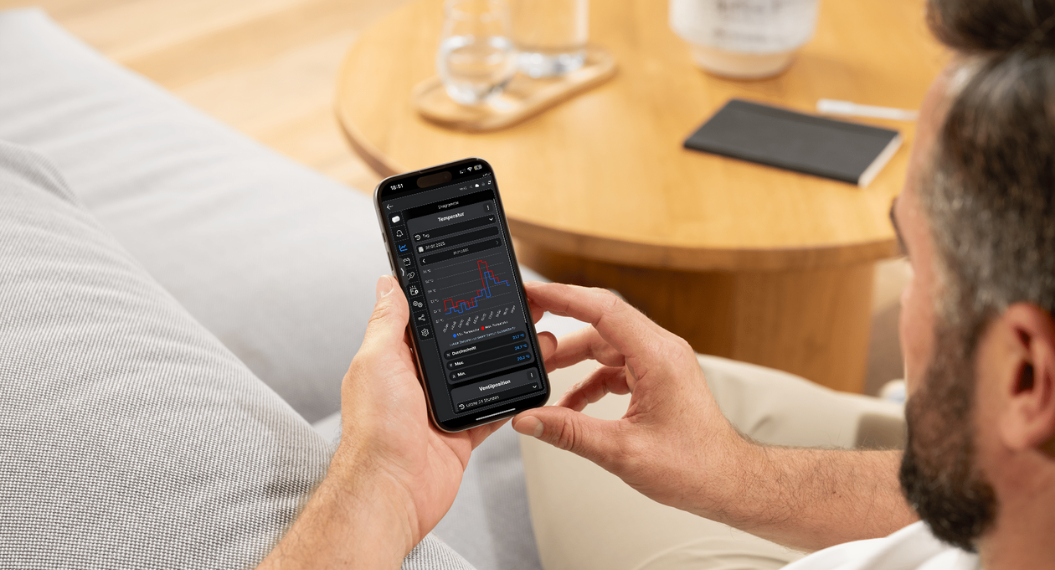
Control via the Shelly App
To control the underfloor heating, you can conveniently use the free Shelly App . Here you store your individual schedules, scenes, and comfort temperatures to optimally adapt the heating performance to your lifestyle. In the app, you connect the temperature sensors with the control elements and set it so that your bedroom can be a bit cooler while the bathroom can be a few degrees warmer. With the app, you can also control your underfloor heating on the go.
If you choose the (paid) premium version of the Shelly App , you can use additional services – including weather, extra Alexa skills, dashboards, and much more.
Temperature control via the Shelly Wall Display
So the whole family can easily access the heating control, you can operate the temperature regulation via the Shelly Wall Display . It communicates both with the respective room thermostat and with the smart actuators that control the heating circuits. You can customize the Wall Display's home screen to your liking, so you can directly access your favorites or control device groups with a tap. You can create a tab for the bedroom that controls your good night routine. When it's time to hit the hay, the Smart Home dims the lights, plays relaxing music, and lowers the temperature of your underfloor heating.
Control underfloor heating with Smart Home: How you can save energy
There are several ways to save energy with the smart control of your underfloor heating. Let's take a closer look at the most important options.

Individual room control of underfloor heating
Individual room control enables efficient management of underfloor heating. It regulates the flow temperature separately for each room instead of turning the entire heating system up and down. For individual room control, you need temperature sensors and room temperature controllers that manage the heating output in each room. This way, only the rooms you use are heated, and only at the times when it should be warm. According to the GEG, individual room control is even mandatory – this also applies to retrofitting the heating system. Only rooms under six square meters or underfloor heating installed before February 1, 2022, are exempt.